On This Page
Introduction
Artificial Intelligence (AI) is increasingly shaping contemporary educational practices, including the teaching and learning of languages. Technologies such as automated writing evaluation, speech recognition, adaptive learning systems, and generative AI tools offer new possibilities for personalized learning, timely feedback, and enhanced learner engagement. In language education, these tools can support the development of linguistic competence by providing flexible and interactive learning opportunities.
At the same time, the growing use of AI has raised important ethical and pedagogical concerns. Current academic and policy discussions highlight issues such as academic integrity, authorship, data privacy, algorithmic bias, transparency, and equitable access to technology. In language learning contexts—where communication, creativity, and human interaction are central—uncritical reliance on AI may limit deeper learning and reduce opportunities for authentic language use.
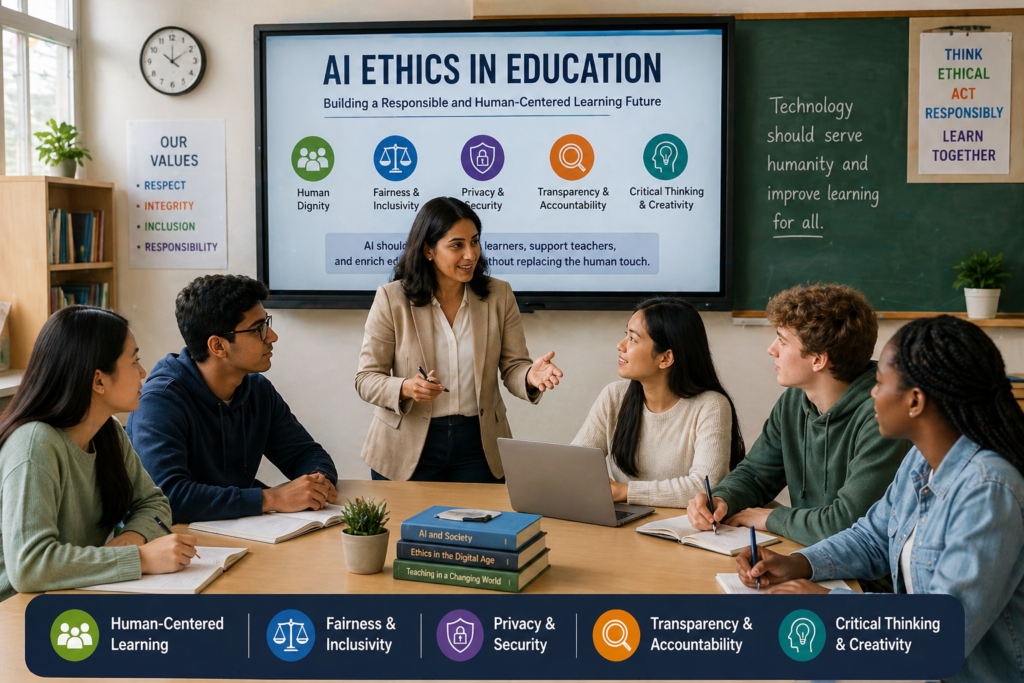
This page presents a balanced and responsible perspective on the use of AI in education. It outlines key ethical challenges, proposes practical strategies for responsible use, and offers guidance for developing classroom-level policies that support ethical awareness, academic integrity, and effective pedagogy.
Ethical Challenges and Responsible Practices in AI Use
The integration of AI in education brings both opportunities and challenges. The following framework outlines key ethical concerns and practical solutions for responsible classroom use.
Ethical Challenges
- AI-assisted plagiarism
- Students may submit AI-generated content without proper acknowledgment, affecting academic integrity.
- Over-reliance on AI tools
- Excessive dependence may reduce critical thinking and independent language production.
- Data privacy concerns
- Use of AI platforms may expose sensitive student data to third-party systems.
- Algorithmic bias
- AI tools may reflect biases present in training data, leading to unfair outcomes.
- Lack of transparency
- Students and teachers may not fully understand how AI tools generate responses.
Responsible Practices
- Clear AI citation guidelines
- Establish rules for acknowledging AI assistance in assignments.
- Designing critical thinking tasks
- Create activities that require personal reflection and analysis beyond AI output.
- Secure data handling policies
- Use platforms that comply with data protection standards.
- Using diverse and inclusive tools
- Select AI tools that minimize bias and support varied learning needs.
- Promoting transparency in AI use
- Encourage open discussion about how AI tools function and are used.
Responsible Use of AI in Language Education Classrooms
The integration of AI in language classrooms requires clear, transparent, and pedagogically grounded policies. A well-defined classroom AI policy helps establish shared expectations, promotes responsible use, and ensures that AI tools support learning rather than undermine it. The following guidelines reflect widely accepted principles of ethical, inclusive, and responsible educational practice.
Guidelines
1. Acceptable Use of AI
Students may use AI tools to support learning activities such as idea generation, language practice, and revision of drafts. However, AI should be used as a supplementary resource and not as a substitute for independent thinking and original work.
2. AI Citation and Transparency
All AI-assisted contributions must be clearly acknowledged. Students should indicate how AI tools were used and distinguish between AI-generated content and their own work, ensuring transparency and accountability.
3. Academic Integrity
Submitting fully AI-generated work as one’s own is not acceptable. Students are expected to demonstrate their own understanding, engage critically with AI outputs, and take responsibility for the final submission.
4. Data Privacy and Security
Students and teachers should avoid sharing personal, sensitive, or confidential information with AI tools. The use of secure and institutionally approved platforms is strongly recommended to protect user data.
5. Equity and Access
Educators should be mindful of differences in students’ access to technology. The use of AI tools should not disadvantage learners who may have limited access to digital resources.
6. Role of the Teacher
Teachers play a central role in guiding responsible AI use. This includes setting clear expectations, designing tasks that promote critical thinking and originality, and supporting students in using AI tools ethically and effectively.
7. Role of the Student
Students are expected to use AI tools responsibly, maintain academic honesty, and actively engage in the learning process rather than relying passively on automated outputs.
AI policies should not restrict innovation; rather, they should ensure that technological tools are used in ways that support meaningful learning, ethical awareness, and academic development.
Responsible Use of AI: A Quick Guide By Prof. Joseph Nehru
This quick guide outlines key principles for the responsible and effective use of Artificial Intelligence in the classroom, helping students and teachers engage with AI tools in a thoughtful and ethical manner.
Responsible Use of AI: Comprehensive Guidelines By Prof. Joseph Nehru
The downloadable Comprehensive Classroom AI Guidelines given below provides a structured framework for the ethical, responsible, and pedagogically effective integration of Artificial Intelligence in language education. It is designed to guide educators and learners in using AI tools critically, transparently, and meaningfully, ensuring that technology enhances—rather than replaces—human learning.
Video Overview: Responsible Use of AI in Language Education Classrooms
This video provides a clear and practical overview of the responsible use of Artificial Intelligence in language education classrooms. It complements the Quick Guide and Comprehensive Guidelines by presenting key principles, ethical considerations, and practical applications for effective and responsible AI integration.
VIDEO LINK: https://youtu.be/lzJw5eqgQEg?si=z4UCdveNnLqGm1tk
My Perspective
As an educator and researcher in the field of English Language Teaching (ELT), I view the integration of Artificial Intelligence in language education as both a significant opportunity and an important responsibility. As highlighted in the video and accompanying guidelines, AI has the potential to enhance learning through personalization, accessibility, and efficiency; however, its use must be guided by sound pedagogical principles and ethical considerations.
Drawing on my experience in international teaching and academic research, I emphasize that AI should complement—not replace—the human dimensions of teaching and learning. Language learning is inherently social, interpretive, and creative, and effective pedagogy depends on meaningful interaction, critical thinking, and reflective engagement. The role of the teacher therefore remains central.
I also advocate for the development of learners’ critical digital literacy. Students should not only learn how to use AI tools, but also how to evaluate their outputs, recognize their limitations, and engage with them responsibly. Awareness of issues such as bias, authorship, and ethical use is essential in contemporary educational contexts.
Ultimately, the future of language education will depend not only on technological advancement, but on how thoughtfully, inclusively, and responsibly these technologies are integrated into teaching and learning practices.