On This Page
- Introduction
- Key Approaches
- Tools with Purpose
- Sample Lesson Flow
- Assessment
- Challenges
- My Perspective
- Conclusion
1. Introduction
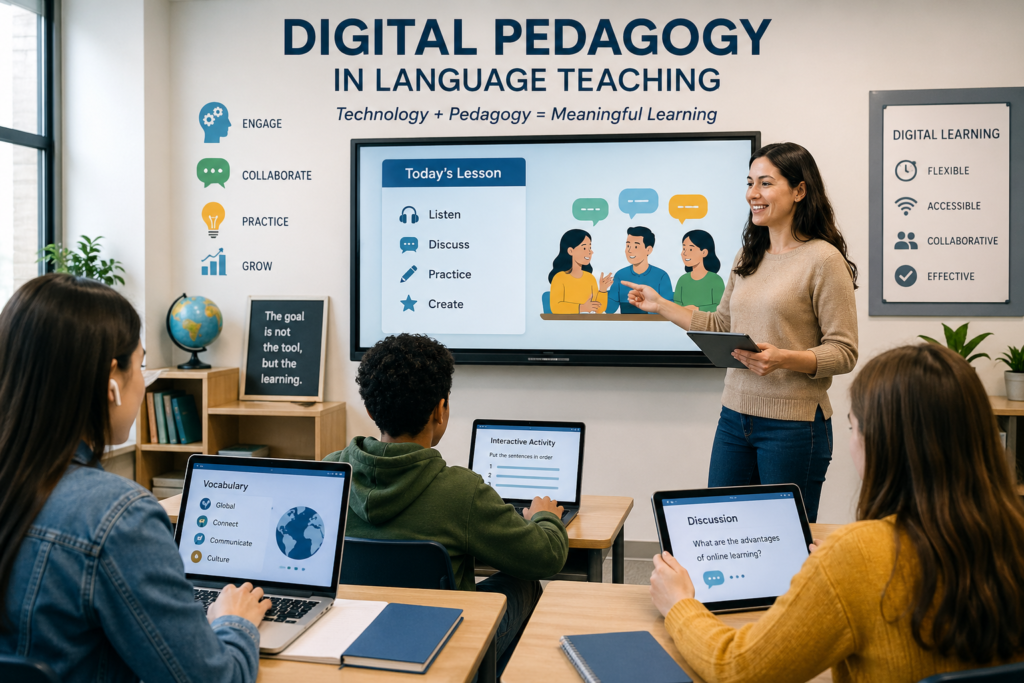
Digital pedagogy refers to the thoughtful integration of technology into teaching and learning processes to enhance engagement, interaction, and learning outcomes. In language education, digital pedagogy is not simply about using tools; it is about transforming how learners interact with language, content, and each other.
With the rapid development of digital technologies and artificial intelligence, language educators are increasingly required to design learning environments that are flexible, inclusive, and learner-centered. Digital pedagogy supports this shift by enabling multimodal learning, personalized instruction, and collaborative knowledge construction.
Importantly, effective digital pedagogy prioritizes pedagogical goals over technological novelty. Technology should serve as a means to facilitate communication, critical thinking, and authentic language use rather than as an end in itself.
2. Key Approaches in Digital Pedagogy
2.1 Blended Learning
Blended learning combines face-to-face instruction with online learning activities. In language teaching, this approach allows learners to practice language skills both inside and outside the classroom, promoting autonomy and continuous engagement.
2.2 Flipped Classroom
In a flipped classroom model, students engage with instructional content (videos, readings, AI-supported materials) before class, while classroom time is used for interaction, discussion, and application.
This approach is particularly effective in language teaching, where class time can be devoted to speaking, collaboration, and feedback.
2.3 Interactive and Collaborative Learning
Digital platforms enable learners to collaborate through discussions, shared documents, and peer feedback. This promotes communicative competence and social interaction, which are central to language acquisition.
2.4 Personalized Learning
Technology allows instruction to be adapted to individual learner needs. AI tools, adaptive platforms, and digital resources can provide customized feedback, helping learners progress at their own pace.
2.5 Multimodal Learning
Digital pedagogy supports the use of multiple modes—text, audio, video, visuals—which enhances comprehension and caters to diverse learning styles.
Technology is effective only when guided by pedagogy.
3. Tools with Pedagogical Purpose
In digital pedagogy, tools should always be selected based on pedagogical objectives, not popularity.
3.1 AI Tools (e.g., ChatGPT, Google Gemini…)
- Brainstorming ideas
- Language practice
- Feedback on writing
👉 Must be used critically and ethically
3.2 Learning Management Systems (LMS)
- Organizing course materials
- Tracking progress
- Facilitating communication
3.3 Collaborative Tools
- Shared documents (e.g., Google Docs)
- Discussion forums
👉 Support peer learning and interaction
3.4 Multimedia Tools
- Videos, podcasts, interactive presentations
👉 Enhance listening and comprehension skills
3.5 Assessment Tools
- Online quizzes
- Immediate feedback systems
👉 Support formative assessment
4. Sample Digital Lesson Flow (Language Class)
Pre-Class (Preparation)
- Guiding questions provided
- Students watch a short video or read a text
- AI tool used for vocabulary exploration
During Class (Interaction)
- Discussion based on pre-class material
- Group activities (role play, debates)
- Teacher facilitation and feedback
Post-Class (Extension)
- Writing task (with AI-supported drafting, if appropriate)
- Peer review through digital platform
- Reflection activity
👉 This structure ensures:
- Preparation
- Interaction
- Reinforcement
Tip for Teachers:
Start small—integrate one digital activity at a time rather than overloading the lesson.
5. Assessment in Digital Pedagogy
Assessment in digital environments should be:
- Continuous (not only final exams)
- Formative (focused on improvement)
- Authentic (real-life language use)
Examples:
- Online discussions
- Digital portfolios
- Reflective journals
6. Challenges and Considerations
While digital pedagogy offers many advantages, it also presents challenges:
- Digital divide (access to technology)
- Over-reliance on tools
- Data privacy concerns
- Need for teacher training
👉 Educators must balance innovation with responsibility.
7. My Perspective
As a language educator, I view digital pedagogy not as a replacement for traditional teaching, but as an extension of it. Technology should enhance human interaction, not diminish it.
In language education, the ultimate goal remains the same: meaningful communication, critical thinking, and learner development. Digital tools—including AI—should be used to support these goals in a thoughtful and ethical manner.
Effective digital pedagogy requires not only technical competence but also pedagogical awareness and reflective practice. Teachers must continuously evaluate how technology influences learning and ensure that it serves the needs of learners.
8. Conclusion
Digital pedagogy in language teaching represents a shift from teacher-centered instruction to learner-centered, technology-enhanced environments. When implemented thoughtfully, it can significantly improve engagement, accessibility, and learning outcomes.
However, the success of digital pedagogy depends on the ability of educators to integrate technology with clear pedagogical purpose and ethical awareness.